
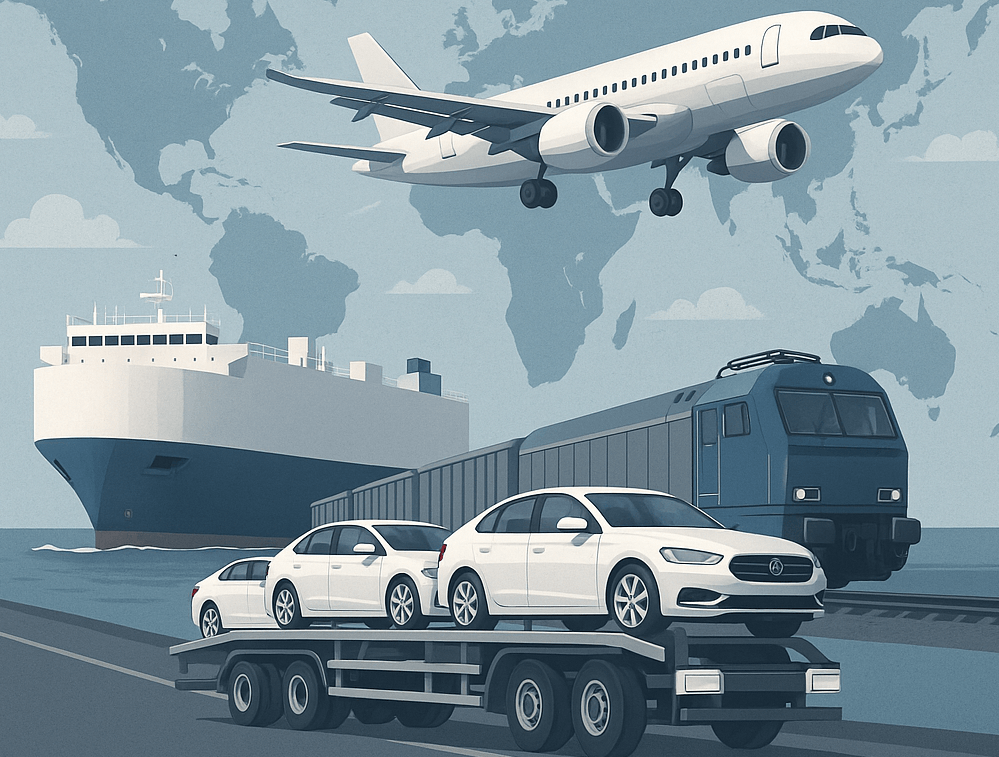
🚗 Diverse Methods of Vehicle Transportation and Global Market Trends
In today’s global economy, the automotive industry remains one of the most vital and far-reaching sectors. Behind every vehicle sold—whether a compact car or a heavy-duty truck—is a complex logistics network that ensures vehicles and parts are delivered efficiently and safely across borders and continents. This blog dives deep into the various methods of vehicle transportation and explores the latest trends shaping the global automotive logistics market.
🚚 Major Methods of Vehicle Transportation
Vehicle transportation involves choosing the right method based on multiple factors such as distance, urgency, cost, vehicle type, and environmental impact. Here’s a look at the main transportation methods used in the industry.
Road Transport (Trucks & Trailers)
In domestic markets like Japan or the United States, road transport remains the backbone of vehicle logistics. Car carrier trailers can haul multiple completed vehicles efficiently, while wing-body trucks are typically used for shipping large auto parts.
Recently, challenges such as a shortage of drivers and the need to cut emissions have prompted innovations like “relay transport,” where drivers switch mid-route, and autonomous truck development. There’s also increasing momentum toward “modal shifts”—transitioning freight from roads to rail or sea.
Maritime Transport (RORO & Container Ships)
For international shipping, Roll-on/Roll-off (RORO) vessels are the dominant method. These ships allow vehicles to be driven directly on and off, enabling fast loading and unloading and supporting bulk export operations.
Auto parts and non-standard vehicles, on the other hand, are often packed in containers and shipped on standard container vessels. Japan, for example, relies heavily on RORO shipping to export cars to the U.S. and Europe. The development of port infrastructure plays a crucial role in optimizing these operations.
Rail Transport
In regions like Europe and China, rail transport is gaining popularity due to its cost-efficiency and lower carbon footprint. China’s “Belt and Road Initiative” has significantly expanded the Eurasian rail network, making rail a competitive option for long-distance transport across continents.
In some parts of Japan and the U.S., rail is also used for long-haul vehicle or component transportation, particularly when integrated with port operations.
Air Transport
Though expensive, air transport is essential when speed is critical—such as for luxury vehicles, emergency parts, or exhibition cars. It is also indispensable in cases where production lines would halt without immediate delivery of key components.
Aircraft logistics play a key role during disasters or supply chain disruptions, ensuring time-sensitive deliveries where no other options are viable.
🌍 Global Automotive Logistics Market Growth
The global automotive logistics market is poised for rapid expansion. According to IMARC, the market size is projected to grow from USD 299.4 billion in 2024 to USD 495.5 billion by 2033.
Several key factors are driving this growth:
- Rise of Electric Vehicles (EVs)
EVs require specialized logistics for batteries and high-voltage components, leading to an evolving logistics framework worldwide. - Diversification of the Supply Chain
With growing geopolitical tensions and pandemic disruptions, automakers are decentralizing production and logistics to spread risk. - Digital Transformation
Technologies such as AI-powered route optimization, IoT vehicle tracking, and Transportation Management Systems (TMS) are streamlining efficiency and transparency. - Growth of Online Sales & Cross-Border E-commerce
Both new and used cars are increasingly being sold online, driving demand for flexible, last-mile, and international vehicle logistics.
Asia-Pacific is expected to be the fastest-growing region, thanks to rapid economic development, urbanization, and infrastructure investments in countries like China, India, and Southeast Asia.
🌱 Sustainability in Automotive Transportation
With the transportation sector being a major contributor to greenhouse gas emissions, there’s a growing emphasis on sustainable practices in automotive logistics.
- Modal Shifts
Logistics companies are moving freight from trucks to lower-emission options like rail and sea. - Introduction of EV and Hydrogen Trucks
Urban delivery fleets are increasingly adopting zero-emission vehicles to reduce pollution. - Use of Returnable Packaging and Pallets
This reduces waste and improves supply chain circularity. - Carbon Footprint Tracking
Many firms are now monitoring and disclosing carbon emissions per shipment, offering customers greener shipping options and regulatory compliance.
Sustainability efforts are not just about meeting environmental goals—they’re also improving operational efficiency and brand reputation globally.
🔮 Future Outlook and Challenges
Looking ahead, the automotive transportation landscape is expected to evolve dramatically:
- Autonomous trucks could help address driver shortages and cut labor costs.
- Specialized logistics for EVs and hydrogen fuel cell vehicles will become the norm.
- Supply chains may shift toward regional production to reduce dependencies and lead times.
- Technologies like blockchain could enhance transparency and security across complex supply chains.
Adapting to changing regulations, political climates, and customer expectations will require flexible and intelligent logistics systems.
📝 Conclusion
Vehicle transportation is more than just moving cars—it’s a strategic function that keeps the global automotive industry in motion. As technologies advance, sustainability becomes a priority, and supply chains grow more complex, logistics will play an even bigger role in the success of automakers and suppliers alike.
Building a smarter, greener, and more resilient vehicle logistics system is not just an industry challenge—it’s an opportunity to redefine mobility in the 21st century.
We write rarely, but only the best content.